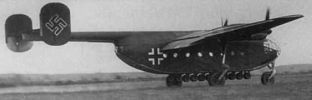
Arado AR 232A680 viewsThe Luftwaffe's Arado AR 232A combat area transport flew for the first time in the summer of 1941, and was a state-of-art flying machine abounding with technological firsts and innovations.
Performance:
Cruise Speed: 288km/h (180 mph)
Range with max. payload (9,921 lb. (4500kg)): 660 miles (1050km)
Min. field lenth at gross weight: 3,100 ft. (945m)
|
|
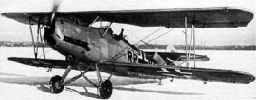
Arado Ar 66c617 viewsThe Ar 66 equipped flying schools from 1933 until into WWII. Over 6000 were built, maybe even 10000. Some were used as night harassments bombers on the eastern front.
|
|
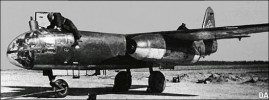
Arado Ar 2401217 viewsThe German Arado 234 was the very first purpose-built jet bomber. While the Ar-234 had very little influence on the outcome of World War II, being much too late and too few in number, it had influence on later aircraft designs. The Ar-234B could be configured either as a bomber or reconnaissance aircraft. It weighed about 5.2 tonnes (11,464 pounds) empty, and about 8.43 tonnes (18,850 pounds) fully loaded. Maximum bomb load was about 1.5 tonnes, carried externally. When used as a reconnaissance aircraft, the AR-234B carried a pair of 300 liter (79 US gallon) drop tanks in place of the bombs.
The powerplants consisted of a pair of Junkers Jumo 004B turbojets, with 900 kilograms (1,980 pounds) thrust each. Maximum speed without bombs or drop tanks was 740 KPH (460 MPH) at 6,100 meters (20,000 feet), but the speed dropped to as low as 660 KPH (410 MPH) with external loads. The prototypes had actually been a good 30 KPH faster than the Ar-234B, due to the more slender fuselage allowed by the lack of landing gear. Tricycle landing gear was fitted. As the Ar-234 landed at high speed, it had a drag chute as standard equipment; it was one of the first aircraft to do so. The rounded nose of the aircraft was covered with plexiglas, giving the pilot an excellent view to the front, but no view to the back except through a periscope. The periscope, which was not provided in the Ar-234 prototypes, also served as a sight for dive-bombing attacks. As a bomber, the Ar-234 was something of a failure. It could not carry enough of a bombload to match the destructive power of the big heavy bombers that were smashing the Reich. However, as a reconnaissance aircraft it proved able to bring back intelligence from airspace denied to prop-driven aircraft.
There were also a number of innovations in the Ar-234 that would be seen in later aircraft.
|
|

Avro Lancastrian557 viewsIn 1944 Avros, at their Waddington factory, began a conversion of the Lancaster, to follow that, which had been made by Victory Aircraft in Canada. This was to make an aircraft for long-range navigational flights. The nose and tail sections were modified and extra fuel tanks added. The new machine was named the Avro Lancastrian; and was delivered to The Empire Air Navigation School at RAF Shawbury.The first plane was called Aries, and it set off on the first, circumnavigation of the world. QANTAS airline of Australia used Lancastrians, on their London to Australia flights. BSAA also used Lancastrians on regular flights to South America; as did Flota Aerea Mercante Argentina. The Canadian Authorities had established a regular route from Canada toBritain earlier. This plane had a range of 4,100 miles with a 7,500 lb payload.
|
|
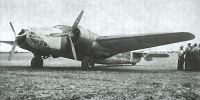
Caproni Ca 135814 viewsThe prototype made its first flight in 4/35 powered by two 800 hp Isotta-Fraschini Asso XI RC Vee engines and driving a wooden two-bladed propeller. The propeller was soon exchanged for a three-bladed metal propeller subsequently accepted for all production versions. The Italian air force felt the Ca.135 had potential and in 1936 ordered 14 examples of the Ca.135 Tipo Spagna (Spanish model), presumably as it was intended to undertake an operational evaluation in the Spanish Civil War. However, none of the aircraft served with the Italian air force in Spain. Trials revealed that the Fiat engines were unreliable and failed to improve performance as significantly as the Piaggio engines, so the few Fiat powered bombers were withdrawn from front-line service and transferred to bomber schools. Thus production of the Ca.135/P.XI was undertaken for a sole export customer, which was the Hungarian air force that received 100 of the type in 1939 and 1940. These aircraft operated with limited success against the Soviets.
|
|
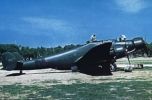
CANT Z 1007673 viewsThe three-engine formula, much developed by Italian manufacturers, had another noteworthy representative in the CANT Z. 1007, the bomber that, together with the SM.79 and BR.20, constituted the Regia Aeronautica's standard equipment during the conflict. A total of 560 aircraft were built in three production series from 1939 to 1943. The Alcione was widely used on all fronts, proving to be an effective aircraft, despite the emergence of problems of structural weakness in extreme climates, such as Africa and Russia, due to its being built entirely of wood. in 10/40, the Z.1007 was largely used in the invasion of Greece, followed by service in the Mediterranean, North Africa and especially against Malta. On the Russian front, the use of the three engine bombers was sporadic and intermittent. At the time of the armistice, the few remaining Z.1007's were split about evenly between the pro-Axis and Co-Belligerent air forces. At its height, the Z.1007 was used by 4 Stormos, 7 Groups and 2 squadrons.
|
|
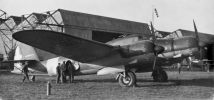
CANT Z.1015648 viewsDevelopment of the Z.1007 with 1500hp Piaggio P.XII RC35
|
|
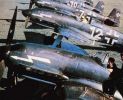
Heinkel He 100570 viewsDisappointed by the loss of the Luftwaffe's fighter orders to BFW and it's Bf 109 and the failure of the He 112, Heinkel set out to build a lighter and faster fighter that was also cheaper and easier to build. Even though the He 100 broke several world speed records, the RLM was solidly supportive of the Bf 109 and failed to order the He 100 into production. Six prototypes were eventually sold to the Soviet Union and three He 100D-0 went to Japan. The three He 100D-0's being armed with two MG 17 and a 20mm MG/FF. The remaining 12 He 100D-1 fighters were used to form a Heinkel-Rostock factory defense unit
|
|
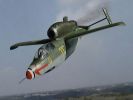
Heinkel He 162643 viewsThe Heinkel He 162 Volksjäger was the second jet engined fighter aircraft to be fielded by the Luftwaffe in WWII. It is know primarily for a series of spectacular disasters during testing. Nevertheless the ambitious production program continued and 300 were complete by the war's end, with another 100 ready for delivery. Only one gruppen had completely re-formed with the He 162 in late April, and they claimed two or three planes in combat before their base was taken over by the British in early May.
|
|
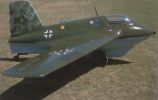
Messerschmitt Me 163B-1493 viewsAlthough the aircraft's two MK 108 30mm cannons were capable of downing a four-engine bomber with only three or four hits, the Komet's high speed, coupled with the cannons' slow rate of fire and short range made effective gunnery nearly impossible against the slow moving bombers. As a result, Me 163 pilots recorded a total of only nine kills. Although capable of reaching its service ceiling of 12,100 m (39,690 ft) in just under three-and-a-half minutes, the Me 163 carried only enough fuel for eight minutes of powered flight. An improved variant of the aircraft with a greater endurance and a tricycle landing gear, designated the Me 163 C, was also produced in small numbers before the war's end, but was not flown operationally.
|
|
|
|
|
|


