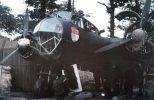
Dornier 17654 viewsThe Dornier 17, were the mainstay of the German bombers during the Blitz on Britain and especially London. Dornier 17 had been an easy target for the Spitfires and Hurricanes of Fighter Command but had proved itself to be a valuable part of the Luftwaffe in campaigns that led up to this battle. The Luftwaffe valued the plane as was shown by production levels for the plane at the start of the war. 1,700 Dornier 17's were built between 1939 and 1940. It made its mark in the attack on Poland in September 1939 and its versatility was such that it was used as a bomber, reconnaissance plane and as a pathfinder by the Luftwaffe. Its limitations were shown in the Battle of Britain, however, when it became clear that the plane was very vulnerable to attacks from the rear and from below and that its defensive armaments were poor. As with other German bombers, against a poor air force, the Dornier 17 did well and the Luftwaffe clearly was over-confident as to its capabilities.
|
|
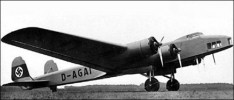
Dornier Do 191293 viewsAlong with the Junkers Ju 89, the Do 19 was developed as part of the "Ural Bomber" program championed by Gen. Walther Wever who forsaw the need for long range strategic bombing capability. When Gen. Wever was killed in April of 1936, the goal of a strategic bombing capability died with him. On April 29, 1937, the Ural-Bomber bomber program was cancelled by Kesselring in spite of protests. Kesselring felt the production and development resources would be better used to develop and build tactical bombers such as the Do 17 and He 111. This philosophy would later haunt and severely handicap the Luftwaffes ability to strike at Russia's production capabilities.
|
|
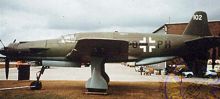
Dornier 335556 viewsAs the Second World War in Europe drew to a close, a powerful new twin- engined fighter was preparing to enter service with the Luftwaffe. This amazing machine was the piston-engined Dornier Do 335. Fitted with Daimler-Benz DB603A-2 engines delivering 1750 hp at take-off, the first example, Do 335 V1 (CP+UA), flew for the first time on 26 October 1943 from Mengen, Wurttemburg, with Flugkapitan Hans Dieterle at the controls. When the US Army overran the Oberpfaffenhofen factory in late April 1945, only 11 Do 335A-1 single seat fighter-bombers and two Do 335A-12 conversion trainers had been completed. A further nine A-1's, four A-4's and two A- 12's were in final assembly, and components and assemblies for nearly 70 more had been completed. Heinkel at Vienna had been unable to build any Do 335A-6 night fighters.
|
|
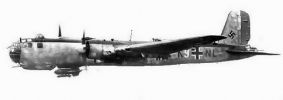
Heinkel He 177560 viewsThe He 177 was a try to devellop a real strategic bomber. The idea to combine two motors on one propeller lead to heavy problems. Due to this and other misstakes in construction, the plane became a deadly trap for many crews and got the the nick-name "Lighter of the Reich". The He 177 saw first operational service in 1942 and was mainly used for maritime warfare in the west. In the mid of 1944 87 He 177 flew an attack on Velikye Luki at the east-front. At the end of the war one machine was modified to carry a german atomic bomb.
|
|
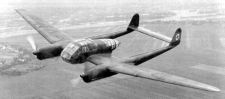
focke wulf 189517 viewsThe Focke Wulf 189 was a reconnaissance aircraft which served with the Luftwaffe (German Airforce) during World War II. Only 846 were built.
The 189 was used mainly on the Eastern Front and was known both as ‘The Flying Eye’, due to the superb all-round vision afforded by its distinctively glazed fuselage, and as the Uhu (Owl). The 189C was an attempt by Focke Wulf to build a ground attack version of it's successful recon plane.
|
|
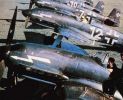
Heinkel He 100570 viewsDisappointed by the loss of the Luftwaffe's fighter orders to BFW and it's Bf 109 and the failure of the He 112, Heinkel set out to build a lighter and faster fighter that was also cheaper and easier to build. Even though the He 100 broke several world speed records, the RLM was solidly supportive of the Bf 109 and failed to order the He 100 into production. Six prototypes were eventually sold to the Soviet Union and three He 100D-0 went to Japan. The three He 100D-0's being armed with two MG 17 and a 20mm MG/FF. The remaining 12 He 100D-1 fighters were used to form a Heinkel-Rostock factory defense unit
|
|
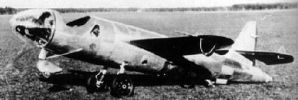
Heinkel He 176732 viewswas the world’s first aircraft to be propelled solely by a liquid-fuelled rocket, making its first powered flight on July 20 1939 with Erich Warsitz at the controls. The He 176 was built to utilise one of the new Walter engines. It was a tiny, simple aircraft, built almost entirely out of wood and lacking even an enclosed canopy. It had a conventional, fixed, tricycle undercarriage, but relied on the weight of the pilot to actually rest on its wheels. Empty, the tail of the plane rested on the ground. Heinkel demonstrated the aircraft to the RLM, but official disinterest led to the abandonment of the company's rocket propulsion programme. The He 176 was placed in the Deutsches Technikmuseum ("German Technical Museum") in Berlin, where it was destroyed in an air raid during World War II.
|
|
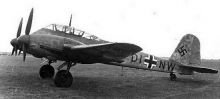
Messerschmidt Me 410 Hornisse816 viewsThe Me 410, was an improvement of the Me 210 proposed as a high altitude fighter/bomber with two DB 603A engines (1750 hp), wing edge slats, a presurized cabine, lengthened engine nacelles and no sweep back on the wings. The Me 410 was waited everywhere in all fronts by 1943 and arrived too late. When it finally arrived, it was usually limited to the role of high-speed bomber or reconnaissance. The Hornisse was more successful in Observation units 1 and 7 than in the interceptor role.
The first prototype V1 was ready by the end of 1942. The entire test program envolved some twenty test planes many of which were modified Me 210s. The armament was the same as in the Me 210.
|
|
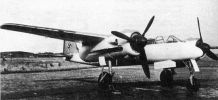
Focke Wulf TA154 Moskito1166 viewsThe Ta154 was developed because the Mosquito night bombers were almost invulnerable for a long time. The airframe was made of wood, a quite unusual feature for a german frontline aircraft, and there was just one production plant for a suitable glue, which was destroyed by a bombing raid. Instead, another glue was used, which caused some damage to nearby wood. This was the reason why Tank cancelled the quantity production after 8 prototypes, 7 pre-serial planes and only 10 serial planes until a better glue was available (indeed, there was none). Another weakness was the bow-wheel landing gear, which caused some crashes. Interesting was the method how the stability of the structure at high speeds was tested; they dragged a hull through water at high speed! The Ta154C was supposed to make use of the modern 1750PS Jumo213 engines.
|
|
|
|


