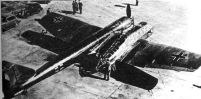
Blohm und Voss BV 141705 viewsThe Bv-141 was a very unusual, asymmetric aircraft. The configuration was adopted to give excellent all-round view from a single-engine aircraft. An extensively glazed nacelle was fitted to the left of a slender tail boom. The Bv-141A (with symmetrical tailplane) was an excellent aircraft but the RLM rejected it as underpowered. The more powerful Bv-141B (with asymmetrical tailplane) had some handling problems. Both types had hydraulic problems.
Its first flight, on 25 February 1938, proved the Bv-141 to be more airworthy than its detractors wanted to believe. Over the next two years three Bv-141A prototypes and 10 Bv-141B production aircraft were completed, but the poor bird never shook the stigma of its disfigured appearance and the Folke Wulf Fw-189A was the winner of the contract.
|
|
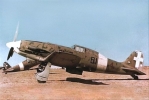
Macchi C.202 Folgore1630 viewswas a World War II fighter aircraft built by Macchi Aeronautica and operated by the Regia Aeronautica (RA; Royal (Italian) Air Force). Macchi aircraft designed by Mario Castoldi received the "C" letter in their model designation, hence the Folgore is referred to as the MC.202. Considered one of the most beautiful fighters to fly with wartime Axis forces, the C.202 was a development of the earlier C.200 Saetta, with a more powerful German Daimler-Benz DB 601 engine and with an extremely streamlined fuselage.[1] Undoubtedly the best wartime fighter to serve in large numbers with the Regia Aeronautica,[2] the Folgore operated on all fronts.[3]
The Folgore went into service with the Regia Aeronautica in July 1941 and immediately proved to be an effective and deadly dogfighter.[4][5] The Australian ace Clive Caldwell, who fought a wide variety of German, Italian and Japanese fighters during 1941–45, later stated that the C.202 was "one of the best and most undervalued of fighters".
|
|
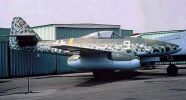
Messerschmitt Me 262 Schwalbe528 viewsThe Me 262A-1a "Schwalbe" ("Swallow") was the first production model of the Me 262. It was produced with four Mk 108 30mm cannon mounted in the nose, in its role as an interceptor, a role that it performed with great promise. it came into the battle far too late, when the Allied air forces had reached formidable capacity; secondly, its engines were a constant source of trouble, frequently failing after no more than 12 hours; the Me 262A-2a "Sturmvogel" ("Stormbird") was reconfigured to carry two 550lb bombs, still retaining the four cannon. A further refinement, Me 262A-2a/U1 had two of the cannon removed to provide space for a bomb-aiming device, and Me 262A-2/U2 carried a prone bombardier in the nose section. Thus, for much of the aircraft's brief combat life, it was used against the wrong type of targets, with even less effect than if it had been used as an interceptor.
|
|
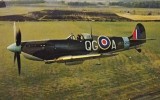
VICKERS ARMSTRONG SUPERMARINE SPITFIRE Mk 1A611 viewsSingle seat fighter powered by a Rolls Royce Merlin II or III liquid cooled in line engine. Maximum speed: 367mph. Armament: eight .303 machine guns. First deliveries to No. 19 Squadron Duxford, June 1938.
|
|
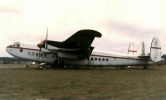
Avro 685 York616 viewsA transport development of the Lancaster, with a bigger fuselage of rectangular cross-section and an additional tailfin. Production during WWII was limited because it was agreed that the US would supply transport aircraft.
|
|
|
|
|


