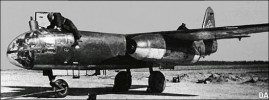
Arado Ar 2401217 viewsThe German Arado 234 was the very first purpose-built jet bomber. While the Ar-234 had very little influence on the outcome of World War II, being much too late and too few in number, it had influence on later aircraft designs. The Ar-234B could be configured either as a bomber or reconnaissance aircraft. It weighed about 5.2 tonnes (11,464 pounds) empty, and about 8.43 tonnes (18,850 pounds) fully loaded. Maximum bomb load was about 1.5 tonnes, carried externally. When used as a reconnaissance aircraft, the AR-234B carried a pair of 300 liter (79 US gallon) drop tanks in place of the bombs.
The powerplants consisted of a pair of Junkers Jumo 004B turbojets, with 900 kilograms (1,980 pounds) thrust each. Maximum speed without bombs or drop tanks was 740 KPH (460 MPH) at 6,100 meters (20,000 feet), but the speed dropped to as low as 660 KPH (410 MPH) with external loads. The prototypes had actually been a good 30 KPH faster than the Ar-234B, due to the more slender fuselage allowed by the lack of landing gear. Tricycle landing gear was fitted. As the Ar-234 landed at high speed, it had a drag chute as standard equipment; it was one of the first aircraft to do so. The rounded nose of the aircraft was covered with plexiglas, giving the pilot an excellent view to the front, but no view to the back except through a periscope. The periscope, which was not provided in the Ar-234 prototypes, also served as a sight for dive-bombing attacks. As a bomber, the Ar-234 was something of a failure. It could not carry enough of a bombload to match the destructive power of the big heavy bombers that were smashing the Reich. However, as a reconnaissance aircraft it proved able to bring back intelligence from airspace denied to prop-driven aircraft.
There were also a number of innovations in the Ar-234 that would be seen in later aircraft.
|
|
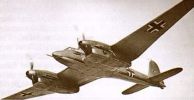
Focke-Wulf 187519 viewsThis plane was excellent when it appeared, but ignored in favor of the Bf110. The pilots in Norway were enthusiastic about its potential and demanded quantity production, but instead they were ordered to give the planes back to Focke-Wulf because they were only in inofficial use. Some Fw187 were also used in the aerial shooting school in Vaerlose, Denmark.
In the facility defense role, they shot down several aircraft. Remarkable was the great maneuvrability; the Rechlin test pilot Heinrich Beauvais was of the opinion that it circled comparable to the Bf109 and rolled only slightly slower than the Bf109, while spped and range were superior. But the disastrous (but good-looking) Me210 and Me410 design was preferred by the air ministry
|
|
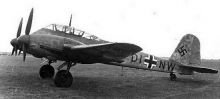
Messerschmidt Me 410 Hornisse816 viewsThe Me 410, was an improvement of the Me 210 proposed as a high altitude fighter/bomber with two DB 603A engines (1750 hp), wing edge slats, a presurized cabine, lengthened engine nacelles and no sweep back on the wings. The Me 410 was waited everywhere in all fronts by 1943 and arrived too late. When it finally arrived, it was usually limited to the role of high-speed bomber or reconnaissance. The Hornisse was more successful in Observation units 1 and 7 than in the interceptor role.
The first prototype V1 was ready by the end of 1942. The entire test program envolved some twenty test planes many of which were modified Me 210s. The armament was the same as in the Me 210.
|
|
|
|


