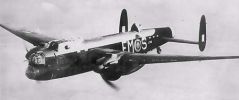
Avro Manchester524 viewsThe Avro Manchester had a relatively brief service career, from November 1940 to June 1942, largely because of problems associated by the unreliability and eventual lack of power shown by the Rolls-Royce Vulture I engines with which it was fitted. The bomber could, however, maintain height on one engine, and in one case an aircraft flew 600 miles from Berlin to its base in England after having had an engine knocked out by gunfire in addition to other extensive damage. In addition to a 10,350 pound bomb load in cavernous bomb-bay nearly half the length of the fuselage, the armament consisted of eight .303-inch machine-guns: two in the nose, two in a dorsal turret, and four in a turret in the tail.
Though unsuccessful the Avro Manchester design demonstrated sufficient promise to warrant further modification.
|
|
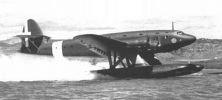
CANT Z 511 Long Range Hydroplane917 viewsThe Cantz 511 Long Range Cargo Hydroplane was first designed by Fillipo Zappata. The first flight took place in Monfalcone (Trieste, north-eastern Italy) in October 1940. It's first operational start took place in February 1942 (Italian territory). On January 1942, the hydroplane had to be employed on different long range routes, as the war against the United States prevented the civil use of CANTZ511 in the Atlantic area. Some had the odd idea of a spectacular mission in the skies of New York, launching one ton of tri-coloured leaflets. Some others thought about a non-stop Rome-Buenos Aires raid (8000 km!). None of these projects was carried out. And it was a real pity, as the test pilot Mario Stoppani - between the end of February and the beginning of March 1942, during the last trials - succeeded in taking off and landing (full loaded) with very rough sea, with 1.5 metres high waves and winds blowing at 55-65 kmh.
|
|
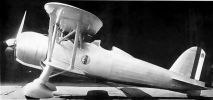
FIAT CR 42 falco589 viewsThe last of the biplane fighters, the Falco flew for the first time on 23 May 1938. It served on most fronts, first as a fighter, and quickly changed to ground support due to the inability of the aircraft to tackle modern allied aircraft. The Fiat CR42 was considered the most agile biplane fighter of WWII, and was certainly a hard target to hit, for the more modern but less maneuverable monoplanes. The Falco was lightly armed, as most of the fighters of it's time were, with 2 12.7mm Breda-SAFAT and still now holds the record of the fastest biplane (439 km/h) in WWII. At the time of El Alamein it was used as ground attack plane. The Falco finished its carreer as a night fighter defending Northern Italy.It was very nice to fly and very manouvrable, with a good pilot could even face the first series Hurricanes.
|
|
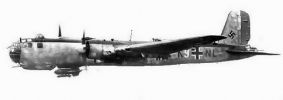
Heinkel He 177560 viewsThe He 177 was a try to devellop a real strategic bomber. The idea to combine two motors on one propeller lead to heavy problems. Due to this and other misstakes in construction, the plane became a deadly trap for many crews and got the the nick-name "Lighter of the Reich". The He 177 saw first operational service in 1942 and was mainly used for maritime warfare in the west. In the mid of 1944 87 He 177 flew an attack on Velikye Luki at the east-front. At the end of the war one machine was modified to carry a german atomic bomb.
|
|
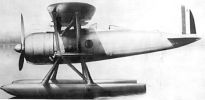
FIAT I CR 42531 views
|
|
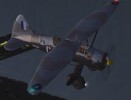
Westland Lysander mk-I burma 1942499 viewsmkI burma 1942 - model for cfs2 - fs2004 - fs2002 simulator, on sale at Icarus:
http://www.icarusgold.com/Lysander.htm
|
|
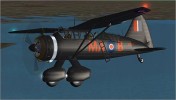
Westland Lysander mkIIIsd N.161 Squadron613 viewsmkIIIsd 1942 N161 Squadron - model for cfs2 - fs2004 - fs2002 simulator, on sale at Icarus:
http://www.icarusgold.com/Lysander.htm
|
|
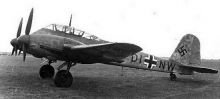
Messerschmidt Me 410 Hornisse816 viewsThe Me 410, was an improvement of the Me 210 proposed as a high altitude fighter/bomber with two DB 603A engines (1750 hp), wing edge slats, a presurized cabine, lengthened engine nacelles and no sweep back on the wings. The Me 410 was waited everywhere in all fronts by 1943 and arrived too late. When it finally arrived, it was usually limited to the role of high-speed bomber or reconnaissance. The Hornisse was more successful in Observation units 1 and 7 than in the interceptor role.
The first prototype V1 was ready by the end of 1942. The entire test program envolved some twenty test planes many of which were modified Me 210s. The armament was the same as in the Me 210.
|
|
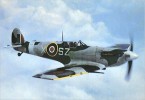
Supermarine Spitfire Mk Vb1136 viewsThe Mk V was produced in greater numbers than any other single mark of Spitfire. It was the main version of the fighter during 1941, replacing the Mk I and II in service in time to take part in the first British counterattacks over France. During the summer of 1941 it held an advantage over the Bf 109, but in September 1941 the Fw 190 made its operation debut, and the Mk V found itself outclassed. Despite this, it remained the main RAF fighter until the summer of 1942, and the low level LF.Mk V remained in use into 1944.
|
|
|
|


