
Avro Lancastrian557 viewsIn 1944 Avros, at their Waddington factory, began a conversion of the Lancaster, to follow that, which had been made by Victory Aircraft in Canada. This was to make an aircraft for long-range navigational flights. The nose and tail sections were modified and extra fuel tanks added. The new machine was named the Avro Lancastrian; and was delivered to The Empire Air Navigation School at RAF Shawbury.The first plane was called Aries, and it set off on the first, circumnavigation of the world. QANTAS airline of Australia used Lancastrians, on their London to Australia flights. BSAA also used Lancastrians on regular flights to South America; as did Flota Aerea Mercante Argentina. The Canadian Authorities had established a regular route from Canada toBritain earlier. This plane had a range of 4,100 miles with a 7,500 lb payload.
|
|

F-86 Sabre553 viewsThe first proposals for the North American Aviation F-86 Sabre were made in 1944, but construction was not begun until after World War II. Many elements of German jet design were implemented in the Sabre. The XP-86 prototype, which would become the F-86 Sabre, flew on 1 October 1947. It often was placed in combat against the superior Soviet MiG-15. Superior US pilot training versus Korean and Chinese training accounted for some of the US success in the air war. Other factors included Soviet pilots' reluctance to engage Americans over battlefields for fear of being captured. Technically, the Soviet Union was not involved in the Korean War, and as such could not afford captured pilots. The Sabre was the first U.S. production aircraft to be fitted with ejector seats. Approximately 9500 were constructed. Several are still held by private owners.
|
|
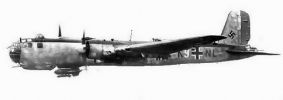
Heinkel He 177560 viewsThe He 177 was a try to devellop a real strategic bomber. The idea to combine two motors on one propeller lead to heavy problems. Due to this and other misstakes in construction, the plane became a deadly trap for many crews and got the the nick-name "Lighter of the Reich". The He 177 saw first operational service in 1942 and was mainly used for maritime warfare in the west. In the mid of 1944 87 He 177 flew an attack on Velikye Luki at the east-front. At the end of the war one machine was modified to carry a german atomic bomb.
|
|
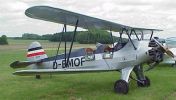
Focke-Wulf Fw 44513 viewsThe Focke-Wulf Fw 44 was a two-seater biplane known as the Stieglitz (Goldfinch).
It was produced by Focke-Wulf for pilot training and aerobatics. The Luftwaffe used the Fw 44C - the final version - almost universally as a trainer during World War II.
|
|
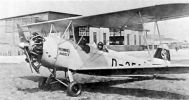
Heinkel He 72557 viewsThe Kadett was introduced in the Luftwaffe in 1933, when the latter was not yet official. It remained one of the most wideley used German primary trainers until 1944. Although it lacked power, it was a pleasant plane to fly and quite comparable to the British Tiger Moth.
Almost all Kadett were He 72B, of which the prodcution took place from 1934 until 1936. After that, only models with a limited number of examples remained in production (He 72BW, He 72B-3). A single example was tested by the Japanese Navy as the "KXHe1"
|
|
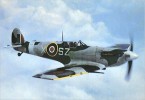
Supermarine Spitfire Mk Vb1136 viewsThe Mk V was produced in greater numbers than any other single mark of Spitfire. It was the main version of the fighter during 1941, replacing the Mk I and II in service in time to take part in the first British counterattacks over France. During the summer of 1941 it held an advantage over the Bf 109, but in September 1941 the Fw 190 made its operation debut, and the Mk V found itself outclassed. Despite this, it remained the main RAF fighter until the summer of 1942, and the low level LF.Mk V remained in use into 1944.
|
|
|
|


