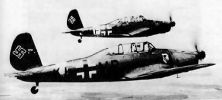
Arado Ar 96720 viewsAdvanced trainer monoplane. At least 11546 built during WWII, and production continued in Czechoslovakia until 1948.
Type: Ar 96B-5
Function: trainer / liaison
Year: Crew: 2 Engines: 1 * 360kW Argus As 10MA-1
Speed: 330km/h Ceiling: 7000m Range: 990km
Armament: 1*mg7.9mm
|
|
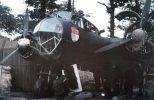
Dornier 17654 viewsThe Dornier 17, were the mainstay of the German bombers during the Blitz on Britain and especially London. Dornier 17 had been an easy target for the Spitfires and Hurricanes of Fighter Command but had proved itself to be a valuable part of the Luftwaffe in campaigns that led up to this battle. The Luftwaffe valued the plane as was shown by production levels for the plane at the start of the war. 1,700 Dornier 17's were built between 1939 and 1940. It made its mark in the attack on Poland in September 1939 and its versatility was such that it was used as a bomber, reconnaissance plane and as a pathfinder by the Luftwaffe. Its limitations were shown in the Battle of Britain, however, when it became clear that the plane was very vulnerable to attacks from the rear and from below and that its defensive armaments were poor. As with other German bombers, against a poor air force, the Dornier 17 did well and the Luftwaffe clearly was over-confident as to its capabilities.
|
|
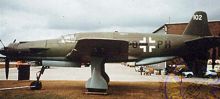
Dornier 335556 viewsAs the Second World War in Europe drew to a close, a powerful new twin- engined fighter was preparing to enter service with the Luftwaffe. This amazing machine was the piston-engined Dornier Do 335. Fitted with Daimler-Benz DB603A-2 engines delivering 1750 hp at take-off, the first example, Do 335 V1 (CP+UA), flew for the first time on 26 October 1943 from Mengen, Wurttemburg, with Flugkapitan Hans Dieterle at the controls. When the US Army overran the Oberpfaffenhofen factory in late April 1945, only 11 Do 335A-1 single seat fighter-bombers and two Do 335A-12 conversion trainers had been completed. A further nine A-1's, four A-4's and two A- 12's were in final assembly, and components and assemblies for nearly 70 more had been completed. Heinkel at Vienna had been unable to build any Do 335A-6 night fighters.
|
|
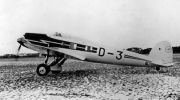
Heinkel He 70581 viewsThe Heinkel He 70 was an aircraft designed as a fast mailplane, inspired by the Lockheed Orion. Its streamlining inspired many other designs. Although useful, it had a relatively brief commercial career, before it was replaced by types which could carry more passengers. As a combat aircraft it was a not a great success, because it rapidly became outdated.
|
|
|
|
|
|


