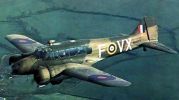
Avro Anson Mk II877 viewsThe Anson first flew in 1935 and went on to serve in a wide variety of roles during the Second World War. Over 11 000 were built and the Anson was still flying for the Royal Air Force in 1968. Anson II's were used primarily to train pilots to fly multi-engined aircraft such as the Lancaster. However wireless operators, navigators, and bomb-aimers used the Anson as well. As a training aircraft the Anson was docile, forgiving, and easy to fly.
|
|
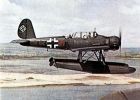
ARADO AR 1961813 viewsthe Ar 196's primary duties consisted of reconnaissance and shadowing of service vessels. While in most respects the Ar 196 is not a formidable aircraft, for a seaplane it's performance exceeded it's Allied counterparts. After Germany's capital ships ceased active participation in the war, most Ar 196's were relegated to sea patrols from shore bases. About 50 planes served with Balkan air forces in the Adriatic and Black Sea.
Variants:
Ar 196A-0, Ar 196A-1, Ar 196A-2: Coastal patrol variant.
|
|
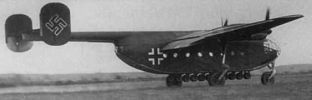
Arado AR 232A680 viewsThe Luftwaffe's Arado AR 232A combat area transport flew for the first time in the summer of 1941, and was a state-of-art flying machine abounding with technological firsts and innovations.
Performance:
Cruise Speed: 288km/h (180 mph)
Range with max. payload (9,921 lb. (4500kg)): 660 miles (1050km)
Min. field lenth at gross weight: 3,100 ft. (945m)
|
|
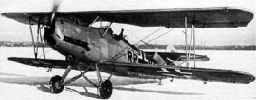
Arado Ar 66c617 viewsThe Ar 66 equipped flying schools from 1933 until into WWII. Over 6000 were built, maybe even 10000. Some were used as night harassments bombers on the eastern front.
|
|
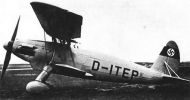
Arado Ar 68F562 viewsInitial deliveries of the Ar 68F were made to the Luftwaffe in the late summer of 1936. commencing with I/JG 134 'Horst Wessel'. By the outbreak of World War II most surviving Ar 68s had been relegated to advanced fighter trainer status with the Jagdflieger-schulen (fighter pilot schools).
|
|
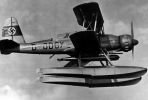
Arado Ar 95635 viewsSix examples of the Ar 95A-0 were built for the Legion Kondor in Marjorca with half of these airframes later being transferred to Nationalist Spain. An additional six were built to fulfill an export order with Chile, half the airframes had floats while the remainder had fixed gear. The final production run comprissed roughly a dozen examples being built for the Luftwaffe and assigned to 3/SAGr 125 in the Baltic and south Finland after the invasion of Russia.
|
|
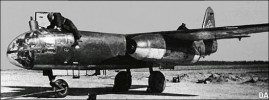
Arado Ar 2401217 viewsThe German Arado 234 was the very first purpose-built jet bomber. While the Ar-234 had very little influence on the outcome of World War II, being much too late and too few in number, it had influence on later aircraft designs. The Ar-234B could be configured either as a bomber or reconnaissance aircraft. It weighed about 5.2 tonnes (11,464 pounds) empty, and about 8.43 tonnes (18,850 pounds) fully loaded. Maximum bomb load was about 1.5 tonnes, carried externally. When used as a reconnaissance aircraft, the AR-234B carried a pair of 300 liter (79 US gallon) drop tanks in place of the bombs.
The powerplants consisted of a pair of Junkers Jumo 004B turbojets, with 900 kilograms (1,980 pounds) thrust each. Maximum speed without bombs or drop tanks was 740 KPH (460 MPH) at 6,100 meters (20,000 feet), but the speed dropped to as low as 660 KPH (410 MPH) with external loads. The prototypes had actually been a good 30 KPH faster than the Ar-234B, due to the more slender fuselage allowed by the lack of landing gear. Tricycle landing gear was fitted. As the Ar-234 landed at high speed, it had a drag chute as standard equipment; it was one of the first aircraft to do so. The rounded nose of the aircraft was covered with plexiglas, giving the pilot an excellent view to the front, but no view to the back except through a periscope. The periscope, which was not provided in the Ar-234 prototypes, also served as a sight for dive-bombing attacks. As a bomber, the Ar-234 was something of a failure. It could not carry enough of a bombload to match the destructive power of the big heavy bombers that were smashing the Reich. However, as a reconnaissance aircraft it proved able to bring back intelligence from airspace denied to prop-driven aircraft.
There were also a number of innovations in the Ar-234 that would be seen in later aircraft.
|
|
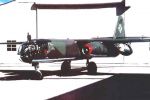
arado ar234544 viewsThe Ar-234 was originally conceived in early 1941 by an engineering team under Professor Walter Blume, director of the Arado aircraft company. Arado projected a maximum speed of 780 KPH (485 MPH), an operating altitude of almost 11,000 meters (36,000 feet), and a maximum range of 2,000 kilometers (1,250 miles). A total of 210 Ar-234Bs and 14 Ar-234Cs were delivered to the Luftwaffe, but with Germany in chaos, only a handful ever got into combat. A final inventory taken on 10 April 1945 listed 38 in service, including 12 bombers, 24 reconnaissance aircraft, and 2 night fighters. These aircraft continued to fight in a scattered and ineffective fashion until Germany surrendered on 8 May 1945. Some were shot down in air combat, destroyed by flak, sometimes their own, or bounced by Allied fighters when they came in to land.
|
|
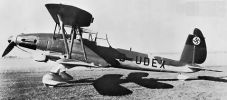
arado ar81638 viewsThe chief rival to the legendary Ju 87, the V3 was superior in most respects but the Ju 87 was chosen primarily due to the fact that the Ju 87 was a monoplane.
|
|
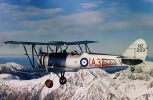
AVRO 626477 viewsThe Avro 626 was developed in 1930 from the Tutor with an optional third seat in a rear cockpit with provision for a gun ring. Numerous sales were made to foreign air forces up to 1939, some of which survived in second-line service until 1945. At least two 626s survived in Belgium's Aeronautique Militaire until 1940.
Avro Prefect: The RAF bought seven Tutor/Avro 626 hybrids, two-seaters with Lynx IVC engines, to Specification 32/34 as navigation trainers for service at School of Air Navigation, Andover. Delivered in 1935, they operated during WWII on miscellaneous duties. Four Lynx-engined Prefects supplied to RNZAF in 1935 were three-seaters; one survived to 1945.
|
|
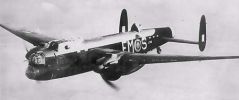
Avro Manchester524 viewsThe Avro Manchester had a relatively brief service career, from November 1940 to June 1942, largely because of problems associated by the unreliability and eventual lack of power shown by the Rolls-Royce Vulture I engines with which it was fitted. The bomber could, however, maintain height on one engine, and in one case an aircraft flew 600 miles from Berlin to its base in England after having had an engine knocked out by gunfire in addition to other extensive damage. In addition to a 10,350 pound bomb load in cavernous bomb-bay nearly half the length of the fuselage, the armament consisted of eight .303-inch machine-guns: two in the nose, two in a dorsal turret, and four in a turret in the tail.
Though unsuccessful the Avro Manchester design demonstrated sufficient promise to warrant further modification.
|
|

Avro Lancastrian557 viewsIn 1944 Avros, at their Waddington factory, began a conversion of the Lancaster, to follow that, which had been made by Victory Aircraft in Canada. This was to make an aircraft for long-range navigational flights. The nose and tail sections were modified and extra fuel tanks added. The new machine was named the Avro Lancastrian; and was delivered to The Empire Air Navigation School at RAF Shawbury.The first plane was called Aries, and it set off on the first, circumnavigation of the world. QANTAS airline of Australia used Lancastrians, on their London to Australia flights. BSAA also used Lancastrians on regular flights to South America; as did Flota Aerea Mercante Argentina. The Canadian Authorities had established a regular route from Canada toBritain earlier. This plane had a range of 4,100 miles with a 7,500 lb payload.
|
|
|
|


