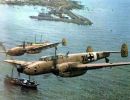
Messerschmitt Bf110707 viewsWilly Messerschmitt however made a creditable attempt with the Bf110, resulting in a machine at that time faster than the Bf109 and similar in speed to the Hawker Hurricane, (end of 1936).
The Bf110 was also tried as a bomber and a night fighter, the latter being its more successful role.
But it must be said that long range, speed, and manoeuvrability, are not mutually compatible and the Bf110 never was more than a maid of all work.
|
|
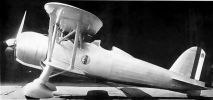
FIAT CR 42 falco589 viewsThe last of the biplane fighters, the Falco flew for the first time on 23 May 1938. It served on most fronts, first as a fighter, and quickly changed to ground support due to the inability of the aircraft to tackle modern allied aircraft. The Fiat CR42 was considered the most agile biplane fighter of WWII, and was certainly a hard target to hit, for the more modern but less maneuverable monoplanes. The Falco was lightly armed, as most of the fighters of it's time were, with 2 12.7mm Breda-SAFAT and still now holds the record of the fastest biplane (439 km/h) in WWII. At the time of El Alamein it was used as ground attack plane. The Falco finished its carreer as a night fighter defending Northern Italy.It was very nice to fly and very manouvrable, with a good pilot could even face the first series Hurricanes.
|
|
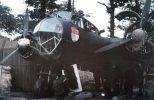
Dornier 17654 viewsThe Dornier 17, were the mainstay of the German bombers during the Blitz on Britain and especially London. Dornier 17 had been an easy target for the Spitfires and Hurricanes of Fighter Command but had proved itself to be a valuable part of the Luftwaffe in campaigns that led up to this battle. The Luftwaffe valued the plane as was shown by production levels for the plane at the start of the war. 1,700 Dornier 17's were built between 1939 and 1940. It made its mark in the attack on Poland in September 1939 and its versatility was such that it was used as a bomber, reconnaissance plane and as a pathfinder by the Luftwaffe. Its limitations were shown in the Battle of Britain, however, when it became clear that the plane was very vulnerable to attacks from the rear and from below and that its defensive armaments were poor. As with other German bombers, against a poor air force, the Dornier 17 did well and the Luftwaffe clearly was over-confident as to its capabilities.
|
|
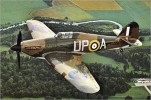
HAWKER HURRICANE Mk IIB546 viewsThe Hurricane bore the brunt of the fighting during the Battle of Britain &, of the 14,00 built, only three examples remain airworthy. This particular machine is painted to represent the aircraft of the late Squadron Leader Archie McKellar
|
|
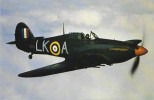
HAWKER HURRICANE Mk IIC661 viewsThis most famous partner to the Spitfire was the predominant fighter in use by the RAF during the Battle of Britain. Designed by Sidney Camm, this aircraft was the first RAF fighter to exceed 300mph & the first eight gun monoplane to enter service. This aircraft saw service throughout the war & was the mount of many great pilots of the War years. It is an interesting & judicious point to note that there were 1,326 Hurricanes & 967 Spitfires on strength during the Battle of Britain, a fine testimony to this fine aeroplane, This particular aircraft was flown by Sqn. Ldr. D. G. Smallwood.
|
|
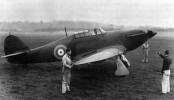
Hurricane MKI593 views The new Mk.I included a deHaviland or Rotol constant-speed metal propeller, ejector exhaust stacks for added thrust, metal-covered wings, armour and other changes. At the start of the war the RAF had taken on about 500 of this later design, and it formed the backbone of the fighter squadrons during the Battle of France and into the Battle of Britain.
Although it may have been an older design, the Hurricane was still a worthy fighter on its own and a reasonable match for the Messerschmitt Bf 109 it faced. In the photo The first production Hurricane Mk.I at [[Brooklands]], November 1937.
|
|
|
|


