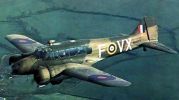
Avro Anson Mk II877 viewsThe Anson first flew in 1935 and went on to serve in a wide variety of roles during the Second World War. Over 11 000 were built and the Anson was still flying for the Royal Air Force in 1968. Anson II's were used primarily to train pilots to fly multi-engined aircraft such as the Lancaster. However wireless operators, navigators, and bomb-aimers used the Anson as well. As a training aircraft the Anson was docile, forgiving, and easy to fly.
|
|
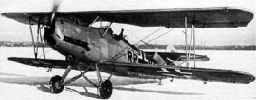
Arado Ar 66c617 viewsThe Ar 66 equipped flying schools from 1933 until into WWII. Over 6000 were built, maybe even 10000. Some were used as night harassments bombers on the eastern front.
|
|
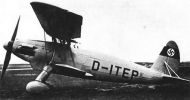
Arado Ar 68F562 viewsInitial deliveries of the Ar 68F were made to the Luftwaffe in the late summer of 1936. commencing with I/JG 134 'Horst Wessel'. By the outbreak of World War II most surviving Ar 68s had been relegated to advanced fighter trainer status with the Jagdflieger-schulen (fighter pilot schools).
|
|
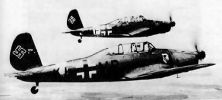
Arado Ar 96720 viewsAdvanced trainer monoplane. At least 11546 built during WWII, and production continued in Czechoslovakia until 1948.
Type: Ar 96B-5
Function: trainer / liaison
Year: Crew: 2 Engines: 1 * 360kW Argus As 10MA-1
Speed: 330km/h Ceiling: 7000m Range: 990km
Armament: 1*mg7.9mm
|
|
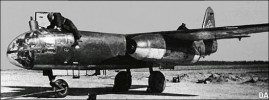
Arado Ar 2401217 viewsThe German Arado 234 was the very first purpose-built jet bomber. While the Ar-234 had very little influence on the outcome of World War II, being much too late and too few in number, it had influence on later aircraft designs. The Ar-234B could be configured either as a bomber or reconnaissance aircraft. It weighed about 5.2 tonnes (11,464 pounds) empty, and about 8.43 tonnes (18,850 pounds) fully loaded. Maximum bomb load was about 1.5 tonnes, carried externally. When used as a reconnaissance aircraft, the AR-234B carried a pair of 300 liter (79 US gallon) drop tanks in place of the bombs.
The powerplants consisted of a pair of Junkers Jumo 004B turbojets, with 900 kilograms (1,980 pounds) thrust each. Maximum speed without bombs or drop tanks was 740 KPH (460 MPH) at 6,100 meters (20,000 feet), but the speed dropped to as low as 660 KPH (410 MPH) with external loads. The prototypes had actually been a good 30 KPH faster than the Ar-234B, due to the more slender fuselage allowed by the lack of landing gear. Tricycle landing gear was fitted. As the Ar-234 landed at high speed, it had a drag chute as standard equipment; it was one of the first aircraft to do so. The rounded nose of the aircraft was covered with plexiglas, giving the pilot an excellent view to the front, but no view to the back except through a periscope. The periscope, which was not provided in the Ar-234 prototypes, also served as a sight for dive-bombing attacks. As a bomber, the Ar-234 was something of a failure. It could not carry enough of a bombload to match the destructive power of the big heavy bombers that were smashing the Reich. However, as a reconnaissance aircraft it proved able to bring back intelligence from airspace denied to prop-driven aircraft.
There were also a number of innovations in the Ar-234 that would be seen in later aircraft.
|
|
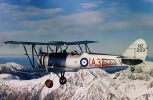
AVRO 626477 viewsThe Avro 626 was developed in 1930 from the Tutor with an optional third seat in a rear cockpit with provision for a gun ring. Numerous sales were made to foreign air forces up to 1939, some of which survived in second-line service until 1945. At least two 626s survived in Belgium's Aeronautique Militaire until 1940.
Avro Prefect: The RAF bought seven Tutor/Avro 626 hybrids, two-seaters with Lynx IVC engines, to Specification 32/34 as navigation trainers for service at School of Air Navigation, Andover. Delivered in 1935, they operated during WWII on miscellaneous duties. Four Lynx-engined Prefects supplied to RNZAF in 1935 were three-seaters; one survived to 1945.
|
|
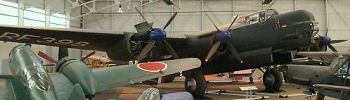
Avro Lincoln463 viewsHeavy bomber developed from the Lancaster, and initially known as the Lancaster B Mk.IV. The Lincoln, bigger and with a longer range, was developed for a British campaign in the far East, but was never used in this role because of the end of WWII. It compared unfavourably with more modern designs like the B-29, but was kept in service until 1963 and saw in combat over Kenya and Malaya. One was shot down on its way to Berlin in 1957.
|
|
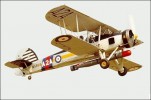
Fairey Albacore1192 viewsThe Fairey Albacore is a single-engine carrier-borne biplane torpedo bomber built by Fairey Aviation between 1939 and 1943 for the Fleet Air Arm. It had a three-man crew and was designed for spotting and reconnaissance as well as delivering bombs and torpedoes. The Albacore, popularly known as the "Applecore", was conceived as a replacement for the ageing Fairey Swordfish, which had entered service in 1936. However, the Albacore served with the Swordfish and was retired before it, being replaced by the monoplane Fairey Barracuda torpedo bomber.
The Albacore prototypes were built to meet Specification S.41/36 for a three-seat TSR (torpedo/spotter/reconnaissance) for the FAA. The first of two prototypes flew on December 12 1938 and production of the first batch of 98 aircraft began in 1939. Early Albacores were fitted with the Bristol Taurus II engine and those built later received the more powerful Taurus XII.
No. 826 Squadron FAA was specially formed to operate the first Albacores in March, 1940. Carrier-based squadrons began operating the Albacore in 1941. Eventually there were 15 FAA squadrons equipped with the plane which operated widely in the Mediterranean. Albacores participated in the Battle of Cape Matapan and the fighting at El Alamein as well as supporting the landings at Sicily and Salerno. During the period September 1941 to end of June 1943 No. 828 Squadron FAA, Hal-Far, Malta, operated a squadron of TSR Fairey Albacores under some of the most severe blitz conditions imaginable during the siege of Malta, mainly against Italian shipping and shore targets in Sicily.
In 1943 the Albacore was replaced by the Barracuda. The last Albacore squadron, No. 841, disbanded in late 1943. The Royal Canadian Air Force took over the Albacores and used them during the Normandy invasion.
|
|
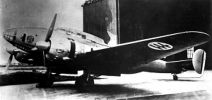
CANT Z 1018 Leone914 viewsIt was clear from the beginning of the flight test program that the performance of the Leone was so high that a production order was certain. This materialized in 1941 in the form of a contract for 300 aircraft to be powered by two Alfa Romeo 135 RC.32 or Piaggio P.XII RC.35 engines, depending on availability. In the event that the Alfa Romeo radial engine was available in larger quantities, and production started in 1943 with a powerplant of two such engines. By the time of the Italian armistace in 9/43 however, deliveries had reached only 10 pre-production and five production warplanes, and a few of these machines saw limited service with the 101st Bombardment Group. Such was the potential of the basic design that two important derivatives were proposed. The first of these was a heavy fighter was a fixed forward armament of 7 20mm cannon as well as a defensive outfit based on three 12.7mm trainable machine guns. The second was a night-fighter with German Lichtenstein SN-2 radar with the antenna in the nose.
|
|
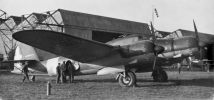
CANT Z.1015648 viewsDevelopment of the Z.1007 with 1500hp Piaggio P.XII RC35
|
|
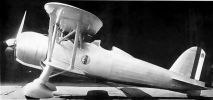
FIAT CR 42 falco589 viewsThe last of the biplane fighters, the Falco flew for the first time on 23 May 1938. It served on most fronts, first as a fighter, and quickly changed to ground support due to the inability of the aircraft to tackle modern allied aircraft. The Fiat CR42 was considered the most agile biplane fighter of WWII, and was certainly a hard target to hit, for the more modern but less maneuverable monoplanes. The Falco was lightly armed, as most of the fighters of it's time were, with 2 12.7mm Breda-SAFAT and still now holds the record of the fastest biplane (439 km/h) in WWII. At the time of El Alamein it was used as ground attack plane. The Falco finished its carreer as a night fighter defending Northern Italy.It was very nice to fly and very manouvrable, with a good pilot could even face the first series Hurricanes.
|
|

F-86 Sabre553 viewsThe first proposals for the North American Aviation F-86 Sabre were made in 1944, but construction was not begun until after World War II. Many elements of German jet design were implemented in the Sabre. The XP-86 prototype, which would become the F-86 Sabre, flew on 1 October 1947. It often was placed in combat against the superior Soviet MiG-15. Superior US pilot training versus Korean and Chinese training accounted for some of the US success in the air war. Other factors included Soviet pilots' reluctance to engage Americans over battlefields for fear of being captured. Technically, the Soviet Union was not involved in the Korean War, and as such could not afford captured pilots. The Sabre was the first U.S. production aircraft to be fitted with ejector seats. Approximately 9500 were constructed. Several are still held by private owners.
|
|
|
|


