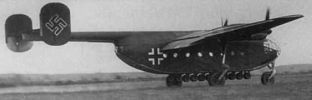
Arado AR 232A680 viewsThe Luftwaffe's Arado AR 232A combat area transport flew for the first time in the summer of 1941, and was a state-of-art flying machine abounding with technological firsts and innovations.
Performance:
Cruise Speed: 288km/h (180 mph)
Range with max. payload (9,921 lb. (4500kg)): 660 miles (1050km)
Min. field lenth at gross weight: 3,100 ft. (945m)
|
|
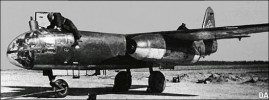
Arado Ar 2401217 viewsThe German Arado 234 was the very first purpose-built jet bomber. While the Ar-234 had very little influence on the outcome of World War II, being much too late and too few in number, it had influence on later aircraft designs. The Ar-234B could be configured either as a bomber or reconnaissance aircraft. It weighed about 5.2 tonnes (11,464 pounds) empty, and about 8.43 tonnes (18,850 pounds) fully loaded. Maximum bomb load was about 1.5 tonnes, carried externally. When used as a reconnaissance aircraft, the AR-234B carried a pair of 300 liter (79 US gallon) drop tanks in place of the bombs.
The powerplants consisted of a pair of Junkers Jumo 004B turbojets, with 900 kilograms (1,980 pounds) thrust each. Maximum speed without bombs or drop tanks was 740 KPH (460 MPH) at 6,100 meters (20,000 feet), but the speed dropped to as low as 660 KPH (410 MPH) with external loads. The prototypes had actually been a good 30 KPH faster than the Ar-234B, due to the more slender fuselage allowed by the lack of landing gear. Tricycle landing gear was fitted. As the Ar-234 landed at high speed, it had a drag chute as standard equipment; it was one of the first aircraft to do so. The rounded nose of the aircraft was covered with plexiglas, giving the pilot an excellent view to the front, but no view to the back except through a periscope. The periscope, which was not provided in the Ar-234 prototypes, also served as a sight for dive-bombing attacks. As a bomber, the Ar-234 was something of a failure. It could not carry enough of a bombload to match the destructive power of the big heavy bombers that were smashing the Reich. However, as a reconnaissance aircraft it proved able to bring back intelligence from airspace denied to prop-driven aircraft.
There were also a number of innovations in the Ar-234 that would be seen in later aircraft.
|
|
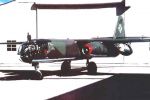
arado ar234544 viewsThe Ar-234 was originally conceived in early 1941 by an engineering team under Professor Walter Blume, director of the Arado aircraft company. Arado projected a maximum speed of 780 KPH (485 MPH), an operating altitude of almost 11,000 meters (36,000 feet), and a maximum range of 2,000 kilometers (1,250 miles). A total of 210 Ar-234Bs and 14 Ar-234Cs were delivered to the Luftwaffe, but with Germany in chaos, only a handful ever got into combat. A final inventory taken on 10 April 1945 listed 38 in service, including 12 bombers, 24 reconnaissance aircraft, and 2 night fighters. These aircraft continued to fight in a scattered and ineffective fashion until Germany surrendered on 8 May 1945. Some were shot down in air combat, destroyed by flak, sometimes their own, or bounced by Allied fighters when they came in to land.
|
|
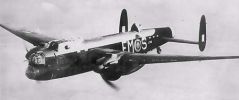
Avro Manchester524 viewsThe Avro Manchester had a relatively brief service career, from November 1940 to June 1942, largely because of problems associated by the unreliability and eventual lack of power shown by the Rolls-Royce Vulture I engines with which it was fitted. The bomber could, however, maintain height on one engine, and in one case an aircraft flew 600 miles from Berlin to its base in England after having had an engine knocked out by gunfire in addition to other extensive damage. In addition to a 10,350 pound bomb load in cavernous bomb-bay nearly half the length of the fuselage, the armament consisted of eight .303-inch machine-guns: two in the nose, two in a dorsal turret, and four in a turret in the tail.
Though unsuccessful the Avro Manchester design demonstrated sufficient promise to warrant further modification.
|
|
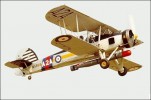
Fairey Albacore1192 viewsThe Fairey Albacore is a single-engine carrier-borne biplane torpedo bomber built by Fairey Aviation between 1939 and 1943 for the Fleet Air Arm. It had a three-man crew and was designed for spotting and reconnaissance as well as delivering bombs and torpedoes. The Albacore, popularly known as the "Applecore", was conceived as a replacement for the ageing Fairey Swordfish, which had entered service in 1936. However, the Albacore served with the Swordfish and was retired before it, being replaced by the monoplane Fairey Barracuda torpedo bomber.
The Albacore prototypes were built to meet Specification S.41/36 for a three-seat TSR (torpedo/spotter/reconnaissance) for the FAA. The first of two prototypes flew on December 12 1938 and production of the first batch of 98 aircraft began in 1939. Early Albacores were fitted with the Bristol Taurus II engine and those built later received the more powerful Taurus XII.
No. 826 Squadron FAA was specially formed to operate the first Albacores in March, 1940. Carrier-based squadrons began operating the Albacore in 1941. Eventually there were 15 FAA squadrons equipped with the plane which operated widely in the Mediterranean. Albacores participated in the Battle of Cape Matapan and the fighting at El Alamein as well as supporting the landings at Sicily and Salerno. During the period September 1941 to end of June 1943 No. 828 Squadron FAA, Hal-Far, Malta, operated a squadron of TSR Fairey Albacores under some of the most severe blitz conditions imaginable during the siege of Malta, mainly against Italian shipping and shore targets in Sicily.
In 1943 the Albacore was replaced by the Barracuda. The last Albacore squadron, No. 841, disbanded in late 1943. The Royal Canadian Air Force took over the Albacores and used them during the Normandy invasion.
|
|
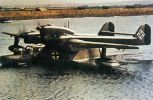
Blohm und Voss BV 138763 viewsThe first prototype which was ready in July 1937 had seveare problems in the air and on the water. A general re-design of the construction followed. Some BV 138 A's were used as transporters for the norwegian campaign in 1940, but late in June 1941 the BV 138 B's saw their service in the role they were constructed for, as sea-reconnaissance planes. From then on they patroled the North-sea and the Arctic-sea and shadowed the well known North-Cape convoys.
The version BV 138 MS was equipped with a mine-sweeping gear and the BV 138 C-1 which was equipped with Radar saw service in anti U-boat attacks.
|
|
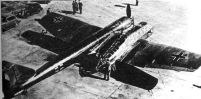
Blohm und Voss BV 141705 viewsThe Bv-141 was a very unusual, asymmetric aircraft. The configuration was adopted to give excellent all-round view from a single-engine aircraft. An extensively glazed nacelle was fitted to the left of a slender tail boom. The Bv-141A (with symmetrical tailplane) was an excellent aircraft but the RLM rejected it as underpowered. The more powerful Bv-141B (with asymmetrical tailplane) had some handling problems. Both types had hydraulic problems.
Its first flight, on 25 February 1938, proved the Bv-141 to be more airworthy than its detractors wanted to believe. Over the next two years three Bv-141A prototypes and 10 Bv-141B production aircraft were completed, but the poor bird never shook the stigma of its disfigured appearance and the Folke Wulf Fw-189A was the winner of the contract.
|
|
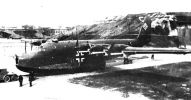
Blohm und Voss BV 2221020 viewsWith a wing span of 46 m and six engines the Blohm & Voss BV 222 was the largest flying boat built in the second world war. On 7th August 1941, the BV 222 V2 which, following experience with the V1, was already equipped with suitable defensive weapons, made it's maiden flight. The first flight took place on 7th September 1940, which was after the start of the second world war, when a machine with a long-range capacity and large cargo space was already of special interest to the military. A total of 12 machines were built in different versions. After completion of trials and conversion, the V2 went into service as a troop transporter with LTS See 222 (air transport command sea 222), before it was finally introduced to 1/SAGr. 129 in Biscarosse, France for the long-range reconnaissance purpose for which it was originally intended.
|
|
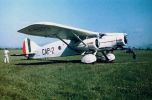
Caproni Ca 133931 viewsThe Ca 133 was modernised version of the Ca 101, cleaned up aerodynamically and given improved engines in an attempt to prolong the type's career as an 16 passenger airliner and second line or "colonial" bomber and transport. Bomber aircraft deployed as military transports, with an interior fitted out to accommodate 18 fully equipped troops, were redesignated Ca i33T and, similarly, conversions for use in an ambulance role were designated Ca 133S. In 1938 a small number of an improved version of the Ca 133 was introduced under the designation Ca 148, serving initially in East Africa, and some survived to fly with the post-war Italian air force.
|
|
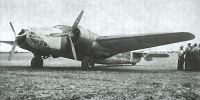
Caproni Ca 135814 viewsThe prototype made its first flight in 4/35 powered by two 800 hp Isotta-Fraschini Asso XI RC Vee engines and driving a wooden two-bladed propeller. The propeller was soon exchanged for a three-bladed metal propeller subsequently accepted for all production versions. The Italian air force felt the Ca.135 had potential and in 1936 ordered 14 examples of the Ca.135 Tipo Spagna (Spanish model), presumably as it was intended to undertake an operational evaluation in the Spanish Civil War. However, none of the aircraft served with the Italian air force in Spain. Trials revealed that the Fiat engines were unreliable and failed to improve performance as significantly as the Piaggio engines, so the few Fiat powered bombers were withdrawn from front-line service and transferred to bomber schools. Thus production of the Ca.135/P.XI was undertaken for a sole export customer, which was the Hungarian air force that received 100 of the type in 1939 and 1940. These aircraft operated with limited success against the Soviets.
|
|
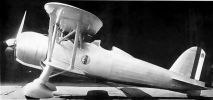
FIAT CR 42 falco589 viewsThe last of the biplane fighters, the Falco flew for the first time on 23 May 1938. It served on most fronts, first as a fighter, and quickly changed to ground support due to the inability of the aircraft to tackle modern allied aircraft. The Fiat CR42 was considered the most agile biplane fighter of WWII, and was certainly a hard target to hit, for the more modern but less maneuverable monoplanes. The Falco was lightly armed, as most of the fighters of it's time were, with 2 12.7mm Breda-SAFAT and still now holds the record of the fastest biplane (439 km/h) in WWII. At the time of El Alamein it was used as ground attack plane. The Falco finished its carreer as a night fighter defending Northern Italy.It was very nice to fly and very manouvrable, with a good pilot could even face the first series Hurricanes.
|
|
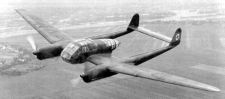
focke wulf 189517 viewsThe Focke Wulf 189 was a reconnaissance aircraft which served with the Luftwaffe (German Airforce) during World War II. Only 846 were built.
The 189 was used mainly on the Eastern Front and was known both as ‘The Flying Eye’, due to the superb all-round vision afforded by its distinctively glazed fuselage, and as the Uhu (Owl). The 189C was an attempt by Focke Wulf to build a ground attack version of it's successful recon plane.
|
|
|
|


