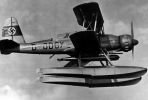
Arado Ar 95635 viewsSix examples of the Ar 95A-0 were built for the Legion Kondor in Marjorca with half of these airframes later being transferred to Nationalist Spain. An additional six were built to fulfill an export order with Chile, half the airframes had floats while the remainder had fixed gear. The final production run comprissed roughly a dozen examples being built for the Luftwaffe and assigned to 3/SAGr 125 in the Baltic and south Finland after the invasion of Russia.
|
|
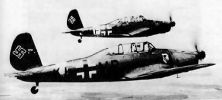
Arado Ar 96720 viewsAdvanced trainer monoplane. At least 11546 built during WWII, and production continued in Czechoslovakia until 1948.
Type: Ar 96B-5
Function: trainer / liaison
Year: Crew: 2 Engines: 1 * 360kW Argus As 10MA-1
Speed: 330km/h Ceiling: 7000m Range: 990km
Armament: 1*mg7.9mm
|
|
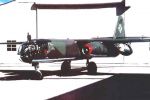
arado ar234544 viewsThe Ar-234 was originally conceived in early 1941 by an engineering team under Professor Walter Blume, director of the Arado aircraft company. Arado projected a maximum speed of 780 KPH (485 MPH), an operating altitude of almost 11,000 meters (36,000 feet), and a maximum range of 2,000 kilometers (1,250 miles). A total of 210 Ar-234Bs and 14 Ar-234Cs were delivered to the Luftwaffe, but with Germany in chaos, only a handful ever got into combat. A final inventory taken on 10 April 1945 listed 38 in service, including 12 bombers, 24 reconnaissance aircraft, and 2 night fighters. These aircraft continued to fight in a scattered and ineffective fashion until Germany surrendered on 8 May 1945. Some were shot down in air combat, destroyed by flak, sometimes their own, or bounced by Allied fighters when they came in to land.
|
|
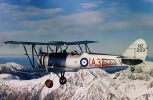
AVRO 626477 viewsThe Avro 626 was developed in 1930 from the Tutor with an optional third seat in a rear cockpit with provision for a gun ring. Numerous sales were made to foreign air forces up to 1939, some of which survived in second-line service until 1945. At least two 626s survived in Belgium's Aeronautique Militaire until 1940.
Avro Prefect: The RAF bought seven Tutor/Avro 626 hybrids, two-seaters with Lynx IVC engines, to Specification 32/34 as navigation trainers for service at School of Air Navigation, Andover. Delivered in 1935, they operated during WWII on miscellaneous duties. Four Lynx-engined Prefects supplied to RNZAF in 1935 were three-seaters; one survived to 1945.
|
|
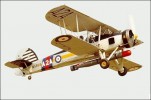
Fairey Albacore1192 viewsThe Fairey Albacore is a single-engine carrier-borne biplane torpedo bomber built by Fairey Aviation between 1939 and 1943 for the Fleet Air Arm. It had a three-man crew and was designed for spotting and reconnaissance as well as delivering bombs and torpedoes. The Albacore, popularly known as the "Applecore", was conceived as a replacement for the ageing Fairey Swordfish, which had entered service in 1936. However, the Albacore served with the Swordfish and was retired before it, being replaced by the monoplane Fairey Barracuda torpedo bomber.
The Albacore prototypes were built to meet Specification S.41/36 for a three-seat TSR (torpedo/spotter/reconnaissance) for the FAA. The first of two prototypes flew on December 12 1938 and production of the first batch of 98 aircraft began in 1939. Early Albacores were fitted with the Bristol Taurus II engine and those built later received the more powerful Taurus XII.
No. 826 Squadron FAA was specially formed to operate the first Albacores in March, 1940. Carrier-based squadrons began operating the Albacore in 1941. Eventually there were 15 FAA squadrons equipped with the plane which operated widely in the Mediterranean. Albacores participated in the Battle of Cape Matapan and the fighting at El Alamein as well as supporting the landings at Sicily and Salerno. During the period September 1941 to end of June 1943 No. 828 Squadron FAA, Hal-Far, Malta, operated a squadron of TSR Fairey Albacores under some of the most severe blitz conditions imaginable during the siege of Malta, mainly against Italian shipping and shore targets in Sicily.
In 1943 the Albacore was replaced by the Barracuda. The last Albacore squadron, No. 841, disbanded in late 1943. The Royal Canadian Air Force took over the Albacores and used them during the Normandy invasion.
|
|
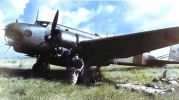
FIAT BR.20 "Cicogna"609 viewsThe Fiat BR.20 Cicogna was the standard Italian bomber of the mid to late 1930's, but it proved to be already obsolete during the French campaign during Italy's entry into World War Two. This bomber was first proposed by Celestino Rosatelli , who envisioned a standardized bomber, in 1934. The two engine BR.20 was first flown on 10 February 1936 at Torino Alitalia and the first 20 units were delivered on 26 November 1937.
Although the aircraft looked realtively sleek and modern, it was already outclassed by other competitors. Nevertheless, a total of 234 BR.20's, 279 BR.20M's and 15 BR.20Bis were built. The BR.20M (Modified) and the BR.20Bis were unique to the original in the change of nose section and engines. These aircrafts were operated in Malta, Battle of Britain, Yugoslavia and the Balkans.
|
|
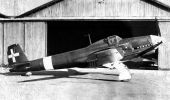
breda Ba.201818 viewsSingle-seat dive bomber. The Ba.201 was a clean low-wing monoplane with an inverted gull wing. It was highly praised by test pilots, except for a disappointing maximum speed. But all available Daimler-Benz DB 601 engines were to be used for fighters, and the Ba.201 was abandoned. Two built.
|
|
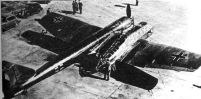
Blohm und Voss BV 141705 viewsThe Bv-141 was a very unusual, asymmetric aircraft. The configuration was adopted to give excellent all-round view from a single-engine aircraft. An extensively glazed nacelle was fitted to the left of a slender tail boom. The Bv-141A (with symmetrical tailplane) was an excellent aircraft but the RLM rejected it as underpowered. The more powerful Bv-141B (with asymmetrical tailplane) had some handling problems. Both types had hydraulic problems.
Its first flight, on 25 February 1938, proved the Bv-141 to be more airworthy than its detractors wanted to believe. Over the next two years three Bv-141A prototypes and 10 Bv-141B production aircraft were completed, but the poor bird never shook the stigma of its disfigured appearance and the Folke Wulf Fw-189A was the winner of the contract.
|
|
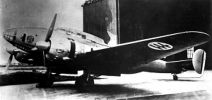
CANT Z 1018 Leone914 viewsIt was clear from the beginning of the flight test program that the performance of the Leone was so high that a production order was certain. This materialized in 1941 in the form of a contract for 300 aircraft to be powered by two Alfa Romeo 135 RC.32 or Piaggio P.XII RC.35 engines, depending on availability. In the event that the Alfa Romeo radial engine was available in larger quantities, and production started in 1943 with a powerplant of two such engines. By the time of the Italian armistace in 9/43 however, deliveries had reached only 10 pre-production and five production warplanes, and a few of these machines saw limited service with the 101st Bombardment Group. Such was the potential of the basic design that two important derivatives were proposed. The first of these was a heavy fighter was a fixed forward armament of 7 20mm cannon as well as a defensive outfit based on three 12.7mm trainable machine guns. The second was a night-fighter with German Lichtenstein SN-2 radar with the antenna in the nose.
|
|
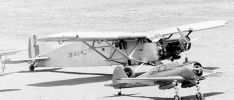
Caproni Ca.111933 viewsUtilized in the colonies in Africa for postal transportation. Internal structure covered in wood. Single-engined development of the Ca.101, used mainly as utility transport. Some had float landing gear. 149 built.
|
|
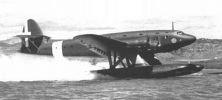
CANT Z 511 Long Range Hydroplane917 viewsThe Cantz 511 Long Range Cargo Hydroplane was first designed by Fillipo Zappata. The first flight took place in Monfalcone (Trieste, north-eastern Italy) in October 1940. It's first operational start took place in February 1942 (Italian territory). On January 1942, the hydroplane had to be employed on different long range routes, as the war against the United States prevented the civil use of CANTZ511 in the Atlantic area. Some had the odd idea of a spectacular mission in the skies of New York, launching one ton of tri-coloured leaflets. Some others thought about a non-stop Rome-Buenos Aires raid (8000 km!). None of these projects was carried out. And it was a real pity, as the test pilot Mario Stoppani - between the end of February and the beginning of March 1942, during the last trials - succeeded in taking off and landing (full loaded) with very rough sea, with 1.5 metres high waves and winds blowing at 55-65 kmh.
|
|
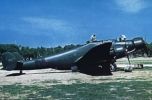
CANT Z 1007673 viewsThe three-engine formula, much developed by Italian manufacturers, had another noteworthy representative in the CANT Z. 1007, the bomber that, together with the SM.79 and BR.20, constituted the Regia Aeronautica's standard equipment during the conflict. A total of 560 aircraft were built in three production series from 1939 to 1943. The Alcione was widely used on all fronts, proving to be an effective aircraft, despite the emergence of problems of structural weakness in extreme climates, such as Africa and Russia, due to its being built entirely of wood. in 10/40, the Z.1007 was largely used in the invasion of Greece, followed by service in the Mediterranean, North Africa and especially against Malta. On the Russian front, the use of the three engine bombers was sporadic and intermittent. At the time of the armistice, the few remaining Z.1007's were split about evenly between the pro-Axis and Co-Belligerent air forces. At its height, the Z.1007 was used by 4 Stormos, 7 Groups and 2 squadrons.
|
|
|
|


